




What is the meaning of Balance Sheet ?
A balance sheet is a financial statement that reports a company’s assets, liabilities and shareholders’ equity at a specific point in time, and provides a basis for computing rates of return and evaluating its capital structure. It is a financial statement that provides a snapshot of what a company owns and owes, as well as the amount invested by shareholders.As a business owner, you’re probably not an amateur at keeping track of what you earn, owe, and have in shareholders’ (owners’) equity. However, if you don’t document or organize these key pieces of financial data in a balance sheet, you may be setting yourself up for failure. A recent Business Administration report found that only about half of all small businesses survive five years. Balance sheet is more like a snapshot of the financial position of a company at a specified time, usually calculated after every quarter, six months or one year. Balance Sheet has two main heads –assets and liabilities.
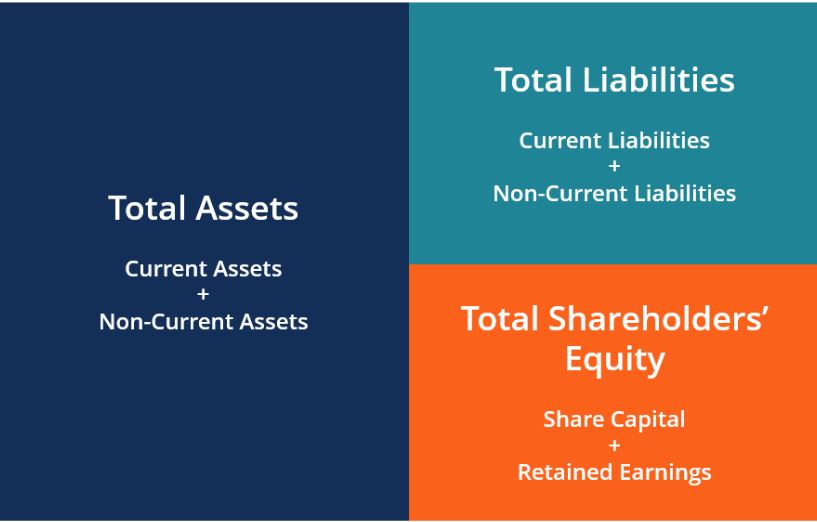
Assets=Liabilities+Shareholders’ Equity
This formula is intuitive: a company has to pay for all the things it owns (assets) by either borrowing money (taking on liabilities) or taking it from investors (issuing shareholders’ equity).
What are the key Features of Balance Sheet ?
What are assets?
Assets are those resources or things which the company owns. They can be divided into current as well as non-current assets or long term assets.
- Cash and cash equivalents are the most liquid assets and can include Treasury bills and short-term certificates of deposit, as well as hard currency.
- Marketable securities are equity and debt securities for which there is a liquid market.
- Accounts receivable refers to money that customers owe the company, perhaps including an allowance for doubtful accounts since a certain proportion of customers can be expected not to pay.
- Inventory is goods available for sale, valued at the lower of the cost or market price.
- Prepaid expenses represent the value that has already been paid for, such as insurance, advertising contracts or rent.
- Long-term investments are securities that will not or cannot be liquidated in the next year.
- Fixed assets include land, machinery, equipment, buildings and other durable, generally capital-intensive assets.
- Intangible assets include non-physical (but still valuable) assets such as intellectual property and goodwill. In general, intangible assets are only listed on the balance sheet if they are acquired, rather than developed in-house.
What is a Liability ?
Liabilities on are debts or obligations of a company. It is the amount that the company owes to its creditors. Liabilities can be divided into current liabilities and long term liabilities.
Another important head in the balance sheet is shareholder or owner’s equity. Assets are equal to total liabilities and owners’ equity. Owner’s equity is used when the company is a sole proprietorship and shareholders’ equity is used when the company is a corporation. It is also known as book value of the company.
- Current portion of long-term debt
- Bank indebtedness
- Interest payable
- Wages payable
- Customer prepayments
- Dividends payable and others
- Earned and unearned premiums
- Accounts payable
- Long-term debt: interest and principal on bonds issued
- Pension fund liability: the money a company is required to pay into its employees’ retirement accounts
- Deferred tax liability: taxes that have been accrued but will not be paid for another year (Besides timing, this figure reconciles differences between requirements for financial reporting and the way tax is assessed, such as depreciation calculations.)
What are the Limitations of Balance Sheet ?
The balance sheet is an invaluable piece of information for investors and analysts; however, it does have some drawbacks. Since it is just a snapshot in time, it can only use the difference between this point in time and another single point in time in the past. Because it is static, many financial ratios draw on data included in both the balance sheet and the more dynamic income statement and statement of cash flows to paint a fuller picture of what’s going on with a company’s business.
Different accounting systems and ways of dealing with depreciation and inventories will also change the figures posted to a balance sheet. Because of this, managers have some ability to game the numbers to look more favorable. Pay attention to the balance sheet’s footnotes in order to determine which systems are being used in their accounting and to look out for red flags.
What are the Advantages for Preparing a Balance Sheet ?
- Liquidity – Comparing a company’s current assets to its current liabilities provides a picture of liquidity. Current assets should be greater than current liabilities so the company can cover its short-term obligations. The Current Ratio and Quick Ratio are examples of liquidity financial metrics.
- Leverage – Looking at how a company is financed indicates how much leverage it has, which in turn indicates how much financial risk the company is taking. Comparing debt to equity and debt to total capital are common ways of assessing leverage on the balance sheet.
- Efficiency – By using the income statement in connection with the balance sheet it’s possible to assess how efficiently a company uses its assets. For example, dividing revenue by the average total assets produces the Asset Turnover Ratio to indicate how efficiently the company turns assets into revenue. Additionally, the working capital cycle shows how well a company manages its cash in the short term.
- Rates of Return – The balance sheet can be used to evaluate how well a company generates returns. For example, dividing net income by shareholders’ equity produces Return on Equity (ROE), and dividing net income by total assets produces Return on Assets (ROA), and dividing net income by debt plus equity results in Return on Invested Capital (ROIC).